
Stratos: An End-to-End Distillation Pipeline for Customized LLMs under Distributed Cloud Environments
Published in AAAI, 2026
✨ Proposed Method
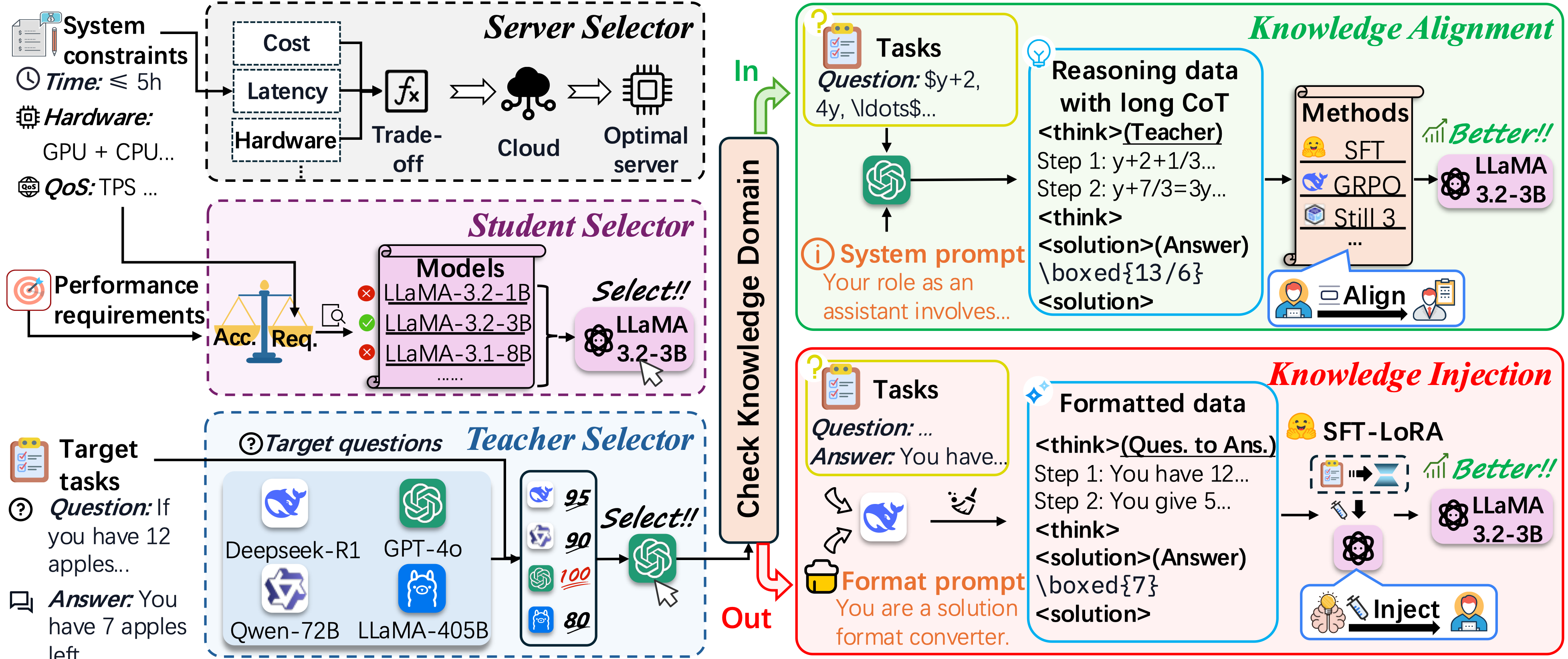
This paper introduces Stratos, an end-to-end Large Language Model (LLM) distillation pipeline designed to automate server/model selection, knowledge distillation, and deployment in distributed cloud environments. To optimize cloud hosting under user-defined budget and latency constraints, Stratos automatically selects Pareto-optimal servers and dynamically matches teacher-student model pairs. Furthermore, it features an adaptive dual-mode knowledge distillation framework that intelligently switches between “Knowledge Alignment” and “Knowledge Injection” based on the task’s complexity and the teacher model’s domain coverage.
📊 Experimental Results
- Exceptional Domain Adaptation: On a rare, domain-specific Mahjong reasoning task, the Stratos-distilled student model achieves four times (4x) the accuracy of its GPT-4o teacher baseline.
- Optimal Resource Efficiency: By successfully balancing accuracy, latency, training time, and cost, Stratos improves the overall deployment score by at least 22% compared to traditional single-objective (e.g., accuracy-first or cost-first) selection methods.
- Strong Generalization: The pipeline demonstrates significant reasoning enhancements and robust generalization capabilities across complex mathematical reasoning benchmarks, such as GSM8K and AIME.
🤝 Collaborating Institutions
Tianjin University; University of Southern California; Tianjin University of Finance and Economics; Paiou Cloud Computing (Shanghai) Co., Ltd




Recommended citation: Ziming Dai, Tuo Zhang, Fei Gao, Xingyi Cai, Xiaofei Wang, Cheng Zhang, Wenyu Wang, and Chengjie Zang. "Stratos: An End-to-End Distillation Pipeline for Customized LLMs Under Distributed Cloud Environments." In Proceedings of the AAAI Conference on Artificial Intelligence, vol. 40, no. 47, pp. 40506-40512. 2026.
Download Paper