
TS-PEFT: Unveiling Token-Level Redundancy in Parameter-Efficient Fine-Tuning
Published in IJCAI-ECAI, 2026
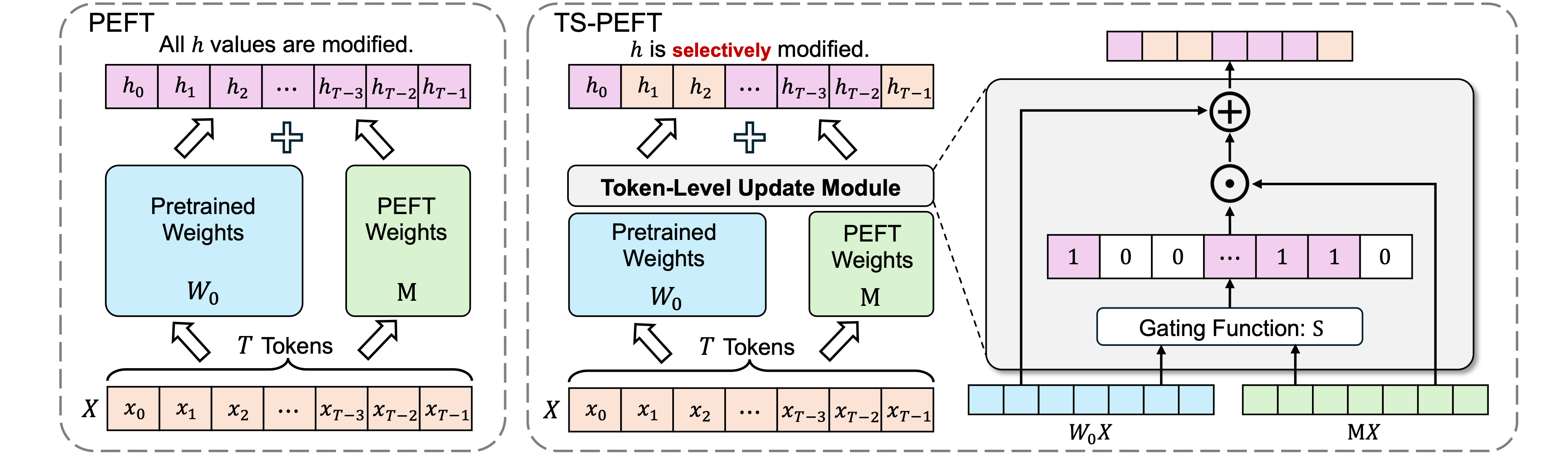
✨ Proposed Method
This paper introduces TS-PEFT, a theoretical framework utilizing proximal optimization that acts as a dynamic probe to identify token-level redundancy during the fine-tuning process of large models. Current Parameter-Efficient Fine-Tuning (PEFT) methods typically operate under the assumption that every token passing through a selected target module contributes equally and requires a parameter update. TS-PEFT challenges this convention by dynamically identifying and removing unnecessary token updates to optimize the adaptation mechanism.
📊 Experimental Results
- Efficiency and Performance: By discarding 30% to 70% of token updates, TS-PEFT consistently matches or exceeds the performance of dense baselines such as LoRA and DoRA.
- Noise Reduction: Extensive experiments demonstrate that indiscriminately updating all tokens is not only computationally superfluous but often introduces optimization noise.
- Module Importance Indicator: In-depth analysis shows that the learned token-level sparsity is a superior indicator of module importance compared to traditional weight criteria, providing a novel data-driven perspective on large models.
🤝 Collaborating Institutions
Tianjin University; Qfin Holdings, Inc.


Recommended citation: Dabiao Ma, Ziming Dai, Zhimin Xin, Shu Wang, Jian Yang, and Haojun Fei. "TS-PEFT: Unveiling Token-Level Redundancy in Parameter-Efficient Fine-Tuning." In the 35th International Joint Conference on Artificial Intelligence. 2026.
Download Paper